Client login


Should I roll my credit card debt into my mortgage renewal?
Your mortgage renewal notice shows up. Meanwhile, you’re carrying $20,000 or $30,000 on credit cards at a much higher interest rate.
The fix seems obvious. Add the cards to the mortgage, swap several payments for one and pay a lower rate.
For some homeowners, that’s a reasonable way to consolidate. But before you do it, know what you’re trading for that lower rate. You may be stretching the debt over many more years. You’re spending home equity that took years to build. And you’re turning unsecured credit card debt into debt secured by your home.
Timing matters too. The last wave of five-year fixed mortgages taken out during the pandemic makes up about 12% of all outstanding mortgages in Canada. Those borrowers can expect their payments to rise by about 15% on average, according to the Bank of Canada’s 2026 Financial Stability Report.
If you’re facing a bigger mortgage payment and credit card debt at the same time, consolidation can look especially tempting. The real question is whether it improves your finances or just moves the debt somewhere else.
Can you add credit card debt to your mortgage at renewal?
Often, yes. The Financial Consumer Agency of Canada lists consolidating higher-interest debts by increasing your mortgage as one of the things to think about at renewal.
But renewing your mortgage and borrowing more are two different transactions. If you stay with your lender and renew the existing balance, the process is usually fairly simple. Once you ask to increase the mortgage to pay off credit cards or other debts, you’re generally asking to refinance. The lender may then look at:
- Your current property value
- Your mortgage balance
- Your available home equity
- Household income
- Credit history
- Other debts
- Debt-service ratios
- Whether you qualify for the larger mortgage
That difference matters more than usual right now. The Bank of Canada estimates that, at current home prices, about 4% of borrowers renewing in 2027 may not be able to refinance under its criteria. In the Toronto area, that rises to about 9%. TD Economics made the same point: the risk is in refinancing, not in a regular renewal, because borrowing more means a new underwriting decision.
The federal banking regulator draws the same line. When you move an uninsured mortgage to a new lender at renewal, Office of the Superintendent of Financial Institutions (OSFI) doesn’t expect the lender to apply the mortgage stress test, but only if neither the loan amount nor the amortization goes up. Taking more equity out of your home doesn’t qualify.
Why rolling credit card debt into a mortgage looks so attractive
Credit card rates are usually far higher than mortgage rates. Move a large balance into a lower-rate mortgage and you might see:
- A lower interest rate
- A smaller required monthly payment
- Fewer separate payments
- More room in the monthly budget
- Credit cards showing a zero balance
If you’ve been watching hundreds of dollars a month disappear into credit card interest, a lower rate and a smaller payment can feel like a huge relief. Sometimes it is real progress. FCAC notes that consolidating high-interest debt into a lower-interest product may save you money and make your debt easier to manage. But it also warns that a longer repayment period can cost you more in interest over time.
So a lower monthly payment doesn’t automatically mean you’re saving money.
The catch: short-term debt can turn into 25 years of debt
Say you have $25,000 on credit cards. Moving it from a card charging around 21% to a mortgage at 5% sounds like an easy call. But how long you take to pay it off changes the math.
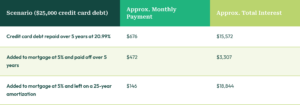
The lower rate can save you real money if you keep paying the consolidated amount down quickly. But if most of the “savings” come from stretching $25,000 over another 20 or 25 years, the monthly payment drops a lot while you end up paying more interest than you would have on the credit card.
That’s why FCAC tells homeowners to think twice before extending their amortization to lower their payments, since it can add thousands or tens of thousands of dollars in interest.
So don’t stop at credit card rate versus mortgage rate. Also compare:
- The repayment period
- Total interest
- Refinancing costs
- Your new mortgage balance
- Your new mortgage payment
- How quickly you plan to repay the consolidated debt
You’re turning unsecured debt into debt secured by your home
Credit card debt is generally unsecured. Nothing specific is pledged against the balance. A mortgage is different, because your home secures it.
When you roll $25,000 of credit card debt into your mortgage, you still owe the $25,000. It just lives inside a larger debt secured against your property. FCAC says you can usually borrow up to 80% of your home’s value against it. It also warns that you may face serious consequences, like the foreclosure of your home, if you can’t pay it back.
There’s another consequence that’s easy to miss. A consumer proposal can only reduce unsecured debt, like credit cards, lines of credit and payday loans. Secured debt, like your mortgage, isn’t part of it. Under a consumer proposal you keep your assets as long as you keep paying your secured creditors in full.
That means rolling credit card debt into your mortgage can take it out of reach of a consumer proposal.
Say you currently have:
- A $400,000 mortgage
- $25,000 in credit card debt
If the $25,000 stays on your credit cards: it’s unsecured. If you later file a consumer proposal, that $25,000 can be included, and you may end up repaying only part of it.
If you roll the $25,000 into your mortgage: you now have a $425,000 mortgage, and all of it is secured against your home. If you later file a consumer proposal or bankruptcy, that $25,000 can’t be reduced. To keep your home, you still have to pay back every dollar of it, plus interest for as long as it sits in your mortgage.
In other words, refinancing can lower your interest rate, but it can also lock in that debt and remove one of your main options for getting relief from it if things get worse.
The rules can work differently if a home is sold and the sale doesn’t cover the full mortgage, so your situation should be reviewed by a Licensed Insolvency Trustee before you refinance.
How much credit card debt can you roll into your mortgage?
Your available equity sets the ceiling. Lenders will usually let your total borrowing against your home reach up to 80% of its value.
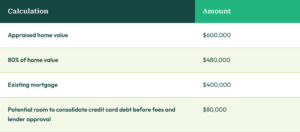
Although that leaves you with $80,000 you could borrow against your home, the lender still has to decide whether you qualify for that amount.
Home values matter too. The Bank of Canada reports that home prices have fallen about 20% since peaking in 2022, and lower home values mean less equity to borrow against.
The biggest risk: paying off the cards and filling them up again
This is where a consolidation that looked great on paper can go wrong.
You refinance, and the lender pays off your credit cards. For the first time in years, the balances read $0. That feels incredible. It can also make the cards feel available again.
Behavioural economists call this mental accounting: we sort money into categories in our heads. Once the card balance disappears, the debt feels gone. Financially, it isn’t. It’s sitting inside your mortgage.
If whatever caused the credit card debt hasn’t changed, the cards can fill back up. A household can end up with:
- A larger mortgage
- Less home equity
- New credit card balances
- More total debt than before the refinance
FCAC is blunt about it: if you keep the spending habits that caused your debt, you’ll accumulate more debt.
So before refinancing, ask what created the balance. Was it a one-time hit, like a major repair, a gap between jobs or a family emergency? Or are the cards covering a shortfall every month because expenses keep running ahead of income? Those are different problems, and they need different fixes.
Is your debt problem really a cash-flow problem?
This may be the most important question in the whole decision.
Say you have $30,000 on credit cards, but every month you’re still putting groceries, gas, utilities or even the mortgage on credit. Moving that $30,000 to your mortgage might lower the rate, but it won’t close the monthly gap between income and expenses.
If your household brings in $7,000 a month and regular expenses plus debt payments keep coming to $7,500, refinancing isn’t a lasting fix unless it changes that math enough to leave you with a real surplus.
FCAC recommends you compare your monthly income to your monthly expenses before deciding how to tackle debt, and to act right away if expenses come out higher.
Look back at your last three months and ask yourself:
- Am I using credit for regular living expenses?
- Am I borrowing again shortly after making payments?
- Would the new mortgage payment actually leave me with a monthly surplus?
- Could I handle a car repair or other emergency without putting it back on a credit card?
- Has the cause of the original debt changed?
If your honest answers point the wrong way, moving the debt may just postpone a bigger decision.
When rolling debt into your mortgage may make sense
It may be worth considering when:
- You have enough home equity
- You qualify for the larger mortgage
- The new interest rate is meaningfully lower
- The credit card debt came from a temporary problem that’s now resolved
- The new mortgage payment fits comfortably in your budget
- You’ve worked out the fees and total interest
- You plan to repay the consolidated amount faster than the full amortization
- You can avoid running the credit card balances back up
- You have room in your budget for unexpected expenses
One of the most useful habits is to keep paying roughly what you were paying before. If you were putting $700 a month toward credit cards and the refinance only adds $150 to your mortgage payment, put some of the difference toward prepayments, if your mortgage allows them. That’s how a lower rate turns into actual savings.
When refinancing may not solve the problem
Take a harder look if:
- You have little home equity available
- You can’t qualify for the larger mortgage
- The new mortgage payment would still be hard to afford
- You need credit every month for groceries or utilities
- Your household has no real monthly surplus
- The payment only works if the debt is stretched over decades
- Your mortgage is already hard to keep up with
- You’ve consolidated credit cards before and the balances came back
- You’re borrowing from one debt to pay another
- Your total unsecured debt is more than you can realistically repay
If any of these sound familiar, the interest rate isn’t the real issue. It’s time to look at your whole financial picture.
What about using a HELOC instead?
A home equity line of credit (HELOC) is another way homeowners consolidate. Instead of a single lump sum, you borrow against your equity as you need it. The HELOC portion can reach up to 65% of your home’s value, within the overall borrowing limit, and HELOC rates are usually variable.
The flexibility helps, but there are trade-offs:
- The interest rate can change
- The available credit makes it easy to borrow more
- Minimum payments may mostly cover interest
- The principal can shrink slowly unless you pay more
- The debt is still secured against your home
A HELOC can work well with a clear repayment plan. Without one, it can turn into another revolving-debt cycle.
What other debt consolidation options should you compare?
Before you put unsecured debt against your home, it’s worth knowing that most consolidation options don’t reduce what you owe. They move the debt somewhere else or lower the interest. Here’s how they compare:
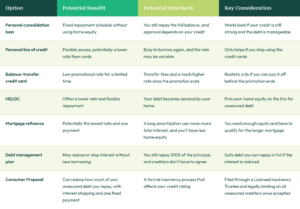
FCAC’s advice is to research and compare products, shop around for the lowest rate and make sure you understand the terms. Don’t choose the monthly payment alone. If the total amount you owe is the real problem, look closely at whether the option you’re considering actually reduces it.
When credit card debt may need a different solution
At some point, moving debt around stops helping. Consider talking to a Licensed Insolvency Trustee if:
- You can’t qualify for consolidation
- Past consolidations didn’t stop the debt from coming back
- You’re using credit for normal living costs
- Payments are unaffordable even at a lower rate
- Your credit cards are at or near their limits
- You’re missing payments
- You’re using one debt to pay another
- You’re thinking about putting more debt against your home just to stay current
When approaching a financial institution for a consolidation loan or an increase in your mortgage, know that lenders will sometimes pick and choose which debts they’re willing to consolidate. If the new payment combined with the remainder of your debts still leaves you struggling to keep up, consolidation may not be the right solution for you.
On the other hand, a consumer proposal will let you tackle all your eligible unsecured debts without adding them to your mortgage. It’s a formal process administered by a Licensed Insolvency Trustee in which you offer creditors a percentage of what you owe, more time to pay, or both. It can last up to five years, and you keep your assets as long as you keep up your payments to secured creditors.
That matters for homeowners. If you can afford your mortgage but unsecured debt is wrecking the rest of the budget, it’s worth understanding how a consumer proposal compares with refinancing before you move those balances onto your house.
Questions to ask before adding credit card debt to your mortgage
Before you sign a refinance, make sure you can answer these:
- How much credit card debt am I consolidating?
- What interest rate am I paying now?
- What will my new mortgage balance be?
- What will my new monthly payment be?
- How much interest will I pay over the full repayment period?
- How much home equity will I have left?
- What appraisal, legal or refinancing fees will I pay?
- Can I make extra mortgage payments without a penalty?
- What caused the credit card debt in the first place?
- Has that changed?
- Could I still afford the mortgage if another unexpected expense came up?
- Have I compared refinancing with other debt solutions?
- Am I comfortable turning this unsecured debt into debt secured against my home value?
Frequently asked questions
Is it a good idea to consolidate credit card debt into your mortgage?
It can be. A lower rate may cut what you pay in interest, especially if you keep paying the consolidated amount down quickly. It’s less helpful if the debt gets stretched over a long amortization or if you keep relying on credit afterward.
Can I add credit card debt when renewing my mortgage?
You may be able to, but increasing your mortgage balance is treated differently from a straight renewal. The lender has to approve the extra borrowing based on your equity, income, credit and other underwriting requirements.
Do I have to pass the stress test to consolidate debt into my mortgage?
With a federally regulated lender, generally yes. Increasing your mortgage amount means going through underwriting again. OSFI’s minimum qualifying rate for uninsured mortgages is currently the greater of your contract rate plus 2% or 5.25%. The straight-switch exemption only applies when the loan amount and amortization don’t increase.
How much home equity can I borrow?
Usually up to 80% of your home’s value in total, including your existing mortgage, subject to lender approval.
Can credit card debt in my mortgage later be included in a consumer proposal?
No. Once it’s added to your mortgage, it’s part of the debt secured against your home. Consumer proposals mainly deal with unsecured creditors, and if you keep the home, you generally keep paying the mortgage. Have a Licensed Insolvency Trustee review your situation before you refinance.
Understand what you’re solving before you refinance
Rolling credit card debt into your mortgage can simplify things right away, and a lower rate and smaller payment can genuinely help. But a refinance changes more than your payment. It can stretch out how long you carry the debt, shrink your home equity and turn unsecured balances into debt secured against your home.
Before you make that change, get clear on why the credit card debt built up and whether refinancing leaves your household with a budget that actually works.
At Bromwich+Smith, a Licensed Insolvency Trustee can review your mortgage, available equity, credit card and other unsecured debts, household income, expenses and current payments. Trustees don’t sell mortgages or refinancing products. Our job is to show you the debt relief options open to you and how they compare for your situation.
If your credit card debt is getting hard to manage, talk to a Trustee before you move it onto your home. You’ll know what you could gain, and what you might be giving up.
Connect with Bromwich+Smith to speak with a Licensed Insolvency Trustee before you add more debt to your mortgage.


Related articles

Back-to-school expenses: How to budget and avoid debt
You are on the couch, half-watching TV, when a back-to-school commercial comes on. It’s that time of year again. Your brain starts building the list…


Family budgeting after debt
There’s a moment a lot of people feel after their debt is finally behind them. It isn’t when you sign the paperwork or make the…

Can you get credit after debt relief? What to know about rebuilding your credit
There’s a question almost everyone asks before they file for a consumer proposal or bankruptcy: will I ever be able to get credit again? It’s…