 Client login


Back-to-school expenses: How to budget and avoid debt
You are on the couch, half-watching TV, when a back-to-school commercial comes on. It’s that time of year again.
Your brain starts building the list without being asked: notebooks, indoor shoes, a new backpack, fall clothes, activity fees, lunches, maybe a laptop or a calculator. Then the real question lands. How much is all of this going to cost?
For a lot of Canadian families, the answer is more than they braced for. 2026 research from the Retail Council of Canada and Caddle put back-to-school spending at $600 to $750 per child once electronics are in the mix. Only 19% of parents expect to be done in one trip, so the costs keep trickling in well after that first receipt.
And it goes well beyond pencils and notebooks. Clothing, technology, school fees, transportation, lunches, activities: each one leans on the family budget. A realistic back-to-school budget helps you sort out what your kids actually need, cut the spending that creeps in, and keeps you from carrying school costs on credit long after the classroom doors open.
Why back-to-school spending can be hard to control
Back-to-school shopping mixes financial pressure with something heavier: the responsibility of making sure your child feels prepared.
A 2025 Leger survey of Canadian parents found 60% saying supply costs had gone up from the year before. Nearly two-thirds said back-to-school expenses hit their household budget hard, and 58% called the whole process stressful.
That stress is not only about the number at the bottom of the receipt. It is the worry that your kid will feel unprepared, or embarrassed, or left out for not having the same clothes, tech, or brand-name supplies as everyone else in class.
That is anticipated regret at work. An optional purchase starts to feel non-negotiable because saying no comes with an emotional price tag. Spending extra can feel easier than lying awake wondering whether you let your child down.
A 2025 Mydoh survey of 1,000 Canadian parents put numbers to it: 40% admitted to overspending because they did not want to disappoint their kids. One in three regularly blew past their plan simply because they had not set a budget before heading out.
Setting a limit is not letting your child down. A budget protects your household’s stability, and it teaches kids the difference between what they need and what they want.
A few things to do before you shop:
- Confirm what the school actually requires
- Separate real needs from preferred brands and upgrades
- Set a ceiling for each category
- Give older kids a fixed amount for the optional stuff
- Bring a written list
- Delay anything that is not needed right away
- Remember you can see what other families buy, but never how they paid for it
What are the most common back-to-school expenses?
A back-to-school budget has to cover more than the official supply list:
- Notebooks, binders, pens, calculators and art supplies
- Backpacks, lunch kits, water bottles and food containers
- Clothing, uniforms, indoor shoes and physical education clothing
- Laptops, tablets, headphones, chargers and software
- Registration and school activity fees
- Sports, music programs, clubs and extracurricular activities
- Before-school and after-school childcare
- Transportation, transit passes, parking and fuel
- Lunches and snacks
- Field trips, school photos, fundraising and yearbooks
Some of these land before the first day. Others do not show up until a teacher confirms what the classroom needs, or a program starts partway through the year. Leaving a little flexibility in the budget keeps every new request from turning into a small emergency.
How much should you budget for back-to-school shopping?
There is no one budget that fits every household. What you spend depends on:
- The number and age of your children
- What they already own
- Whether uniforms are required
- Technology needs
- Transportation and childcare
- Sports and extracurricular activities
- School-specific fees and requirements
Start with a separate estimate for each child. It makes the different needs easier to see, and it stops one big purchase from vanishing into a vague household total.
Then split the budget into categories:
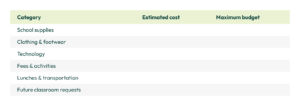
Estimated cost is your best guess at what the category needs. Maximum budget is what your household can actually cover without borrowing. Leave a bit unspent if you can. Teachers add requests once class is underway, and kids have an uncanny gift for remembering a required item at 9:17 p.m. on a Sunday.
How to create a back-to-school budget
Start with the list your child’s school or teacher hands out. Then look at your income and your regular bills, and work out what is left after housing, groceries, utilities, transportation, childcare, and the debt payments you already carry. From there, sort the purchases into three groups.
Needed before the first day
The things your child needs to walk in on day one: indoor shoes, a backpack, the specific supplies the teacher named.
Needed later
Fall clothing, sports gear, field-trip fees, supplies for a class that does not start until later in the term.
Optional or preferred
Brand-name upgrades, replacements for things that still work fine, the wants rather than the needs.
Cover the first group first, set money aside for the second, and only touch the third when there is genuine room. With older kids, a fixed amount for the preferred items works well. They might spend it on one pricier pair of shoes, and learn firsthand that the choice leaves less for everything else.
How to save money on back-to-school shopping
Before you buy anything, shop in your own house first. Dig through closets, desks, drawers, and last year’s backpacks for supplies that still have life in them. Test the calculators, headphones, laptops, and chargers before you replace them. Check what clothing and shoes still fit.
Reusing something is not a thing to hide or apologize for. In that 2025 Leger survey, 34% of Canadian parents said they planned to reuse supplies from past years or older siblings.
Once you know what is actually missing, put your energy where it counts:
- Compare prices between retailers
- Check unit prices when buying multipacks
- Use price matching when it is available
- Choose generic or store-brand supplies when the quality is comparable
- Use flyers and promotions for items already on your list
- Avoid buying something only because it is discounted
- Share bulk packages with another family
- Look for second-hand electronics, uniforms, sports equipment and musical instruments
- Consider consignment stores, clothing swaps and online marketplaces
- Wait for clearance sales before buying non-essential items
- Avoid buying an entire fall and winter wardrobe at once
The Retail Council of Canada’s 2026 research found 85% of parents were actively hunting for deals when they chose where to shop, and most expected to make two or three trips, usually because they were still comparing prices or waiting on a finalized school list. Spreading it out helps your cash flow. It also makes the total easier to lose track of, so keep every purchase in the same budget even when the shopping stretches over weeks.
Back-to-school expenses families often forget
The spending does not stop when the first bell rings. More costs land throughout the year:
- Classroom supplies requested after school begins
- Field trips
- School photos and yearbooks
- Fundraising
- Sports and activity registration
- Uniforms, equipment and performance clothing
- Technology subscriptions
- Replacement chargers or headphones
- Lunches and snacks
- Professional development day childcare
- Transportation and parking
- Winter clothing and footwear
- Teacher gifts and appreciation events
Hold back part of your budget for these instead of blowing through it all before day one.
Should you use credit or buy now, pay later for school supplies?
There is a real difference between using a credit card as a tool and leaning on it because the purchases are out of reach. If you can clear the full balance by the due date, a card can be a handy way to pay and to track what you spent. Carry that balance, though, and interest inflates the cost of every shirt, binder, and device. A store discount or a rewards perk does not save you anything if the purchase sits on the card for months.
Buy now, pay later plans slice the cost into installments. That makes a purchase feel cheaper, even though the total never budges. Four payments of $75 sound gentler than $300 today. The trouble starts when a few of these plans overlap, with each other and with your regular bills.
A 2024 Abacus Data survey found 16% of Canadian back-to-school shoppers planned to use a pay-later service. The same survey found 15% expected to shop beyond their means just to get everything they felt was necessary.
Before you reach for credit or an instalment plan:
- Look at the full purchase price
- Add together all active instalment payments
- Include future payments in your monthly budget
- Check whether you can still pay regular bills when the instalments are due
- Avoid depending on income that is already allocated to other expenses
- Do not assume a future bonus, refund or raise will cover the purchase
Splitting a purchase into payments does not make it affordable if those payments do not fit your budget.
What to do if you cannot afford everything on the school list
Not being able to buy everything at once does not make you a bad parent.
Start by calling the school. Ask what is essential for the first day and what can wait. A lot of schools keep donated supplies, technology programs, or other resources for families who need a hand.
You can also:
- Look for local school-supply drives and community programs
- Ask whether used or refurbished technology is acceptable
- Delay optional clothing, electronics and brand-name upgrades
- Speak honestly with older children about the available budget
- Ask whether the school offers payment plans for activities or fees
- Review the wider household budget before borrowing
Steer clear of payday loans and other high-cost borrowing for school costs. Patching an immediate shopping gap with an expensive short-term loan tends to hand you a much bigger problem once the school year is underway. Asking for help is the responsible move, and not a shameful one. Better to find out what support exists than to take on debt your household cannot repay.
Start saving for next year’s school expenses
Back-to-school costs are predictable, even if the exact figure is not. Once the shopping season winds down, add up what you really spent: the purchases after day one, the fees, the clothing, the activities. That total becomes your target for next year. Say you spent $1,200 and you are paid twice a month. Setting aside $50 from each of 24 paycheques gets you to $1,200 before the next back-to-school season starts.
Park the money in its own savings category and automate the transfer if you can. Bump the target up when you know a laptop, a uniform, or a pricey piece of sports equipment is coming. A little put away regularly turns a stressful seasonal hit into a manageable line in your budget.
When back-to-school costs reveal a larger debt problem
Sometimes back-to-school shopping strains your finances without being the actual cause of the strain. It may be worth looking at the bigger picture if:
- You rely on credit for school expenses every year
- You are still paying for last year’s purchases
- Buying school supplies leaves no money for groceries or bills
- You miss one payment to afford another expense
- Credit card balances keep climbing
- You have several credit cards or instalment plans active at once
- You can only manage the minimum payments
- You use payday loans between paycheques
- Your budget has no room for predictable annual expenses
- You have cut spending and still cannot catch up
None of these mean you failed at budgeting. Sometimes the total debt is simply too big for everyday budgeting and cost-cutting to fix.
How Bromwich+Smith can help
Every parent wants their kid walking in on the first day feeling prepared and confident. But debt you cannot afford brings a financial stress that outlasts the school year by a long way. Bromwich+Smith can help you look at your whole financial picture, including:
- Credit cards
- Personal loans
- Lines of credit
- Payday loans
- Tax debt
- Other unsecured debts
A Licensed Insolvency Trustee can walk you through the debt-relief options available in Canada. Depending on where you stand, those might include budgeting, debt consolidation, credit counselling, a consumer proposal, or bankruptcy.
A consumer proposal is a formal process administered by a Licensed Insolvency Trustee. It can let you settle part of your unsecured debt through a single structured payment. Bankruptcy comes into play when repaying the debt is no longer realistic.
Talking to a Licensed Insolvency Trustee does not mean you have to file anything. It is a chance to understand your options through confidential, judgment-free guidance. If the regular costs of family life can no longer be covered without borrowing, reach out to Bromwich+Smith and take the first step toward rebuilding your worth.


Related articles

Family budgeting after debt
There’s a moment a lot of people feel after their debt is finally behind them. It isn’t when you sign the paperwork or make the…

Your September money reset: How to get your finances in order before the holidays
September has a way of pulling your finances back into focus. The vacation is over. The school supplies are bought. Sports, dance, and the other…

Budgeting tips for beginners
Budgeting can feel overwhelming when you’re just getting started. For a lot of people, the word “budget” sounds like punishment. No fun. No coffee. No takeout. No…