 Client login


Can you get credit after debt relief? What to know about rebuilding your credit
There’s a question almost everyone asks before they file for a consumer proposal or bankruptcy: will I ever be able to get credit again?
It’s a fair thing to worry about. Credit affects whether you can finance a vehicle, qualify for a mortgage, rent a place or handle a large purchase without draining your savings. So even when the debt has clearly stopped being manageable, choosing a debt relief option you know will show up on your credit report is hard.
Here’s the short version. A consumer proposal or bankruptcy will affect your credit, and it will affect it significantly. But it doesn’t sit there forever, and you don’t have to wait for it to disappear before you start rebuilding. Most people begin rebuilding while the filing is still on their credit report.
Knowing what actually happens to your credit and how you can rebuild it tends to make the decision feel less like a leap in the dark.
How does debt relief affect your credit?
When you file a consumer proposal or bankruptcy, information about the filing is reported to Canada’s credit reporting agencies. Both will affect your credit profile. The Office of the Superintendent of Bankruptcy notes that people who file a consumer proposal or bankruptcy are generally assigned the lowest possible credit rating.
Most people hear that and picture a number falling off a cliff. What’s actually happening is more specific, and it’s worth understanding before you decide anything.
What credit rating will you receive?
Alongside your three-digit credit score, Canada’s credit bureaus assign a rating to each individual account on your report. The letter in front tells you what kind of account it is:
- R for revolving credit, like credit cards and lines of credit
- I for instalment loans, like a car loan or a personal loan
- O for open accounts, like a cellphone plan
Most consumer debt sits in the R category, which is why people usually talk about their “R rating.”
The number beside the letter is what does the work. It runs from 0 to 9, and it describes how that specific account is being paid:
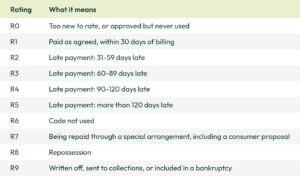
In a consumer proposal, the accounts are generally rated R7. An R7 tells a lender the debt is being repaid through a formal arrangement rather than left unpaid.
In a bankruptcy, the accounts are generally rated R9. R9 sits at the bottom of the scale.
That difference matters to some lenders, and it’s one of the practical distinctions between the two options. It’s also only one factor among several. An R7 is not a good rating, and neither option leaves your credit untouched.
Three things about these ratings that tend to get missed:
They’re assigned per account, not to you. If five credit cards are included in your proposal, each one carries its own R7. Accounts obtained after a consumer proposal keep whatever rating they already have.
They aren’t your credit score. The rating and the score are two separate pieces of information sitting on the same report. Lenders look at both, along with your income and your current obligations.
They aren’t permanent. Ratings update as accounts are resolved, and the filing itself comes off your report on a set timeline.
Your credit is likely already affected before you file.
People tend to overlook this part.
By the time someone is working with a Licensed Insolvency Trustee, there’s often already:
- Missed or late payments
- Credit cards at or near their limits
- Accounts in collections
- High credit utilization
- Several outstanding loans running at once
- Months of paying minimums and watching the balance barely move
All of that is already pulling your credit score down, and it’s already showing up in your ratings. An account that went to collections a year ago is sitting at R9 right now, before you speak to anyone. People are often surprised by that. Filing a consumer proposal or bankruptcy doesn’t always move the rating as far as they expected, because a good portion of the damage is already on the report.
The fear of wrecking your credit is exactly what keeps people making minimum payments on debt they have no realistic way of repaying. Making those payments can feel like you’re protecting your credit score. But if the balance keeps growing, or barely moves after months or years of payments, the score isn’t really benefiting from the situation either.
How long does a consumer proposal stay on your credit report?
Two things decide this: which credit bureau is reporting it, and how quickly you finish.
Equifax
Equifax removes a Consumer Proposal three years after you’ve paid off all the debts included in it, or six years from the date it was filed, whichever comes first.
TransUnion
TransUnion removes the proposal, and every account reported as satisfied through it, three years from the date you satisfied the proposal, or six years after the date you defaulted on the account, whichever comes first.
The three-year rule is the same at both bureaus. The six-year backstop is measured differently: Equifax counts from the date the proposal was filed, TransUnion counts from the date the account went into default. Most people stop paying before they file, so those dates usually aren’t the same, and the two reports can clear at slightly different times.
The Financial Consumer Agency of Canada describes the general rule as three years after the Consumer Proposal has been paid, or six years after you sign the proposal, whichever comes first.
What this looks like in practice
Say you file a consumer proposal in January 2027. Using the Equifax rule, here’s how the finish date changes things:

In the first row, finishing early pulls the date forward by a full year. In the last row it doesn’t, because the six-year backstop has already arrived. A proposal can run for a maximum of five years, and someone who takes the full term hits the six-year mark before the three-years-after-completion mark ever comes around.
Why finishing early actually matters
There’s a tipping point in those numbers, and it’s worth knowing.
Finishing your proposal in less than three years is what shortens the reporting period. Past that, the six-year backstop takes over and your completion date stops affecting the outcome.
That’s a practical reason to put lump sums toward your proposal if your circumstances improve, whether that’s a tax refund, a bonus or a change in income. It isn’t only about being done sooner. It’s the one part of this timeline you have any control over.
Your Licensed Insolvency Trustee can tell you what paying ahead would look like in your situation and whether it makes sense for you.
After you complete it
When you finish the terms, you receive a Certificate of Full Performance. That’s your proof the proposal was completed.
Pull both credit reports a little while afterward and check the information is showing correctly. You’re looking for the proposal marked as completed, and the accounts included in it reported accurately. Errors do happen, and nobody else is going to catch them on your behalf.
The good news is that when the proposal comes off, the accounts tied to it go with it. TransUnion removes the proposal and every account reported as satisfied through it at the same time.
How long does bankruptcy stay on your credit report?
How long a bankruptcy shows on your credit report depends on two things: which credit bureau is reporting it, and whether you’ve been discharged.
Equifax
Equifax removes a first bankruptcy six years after your discharge date. If no discharge date is reported, it comes off seven years after the date you filed.
TransUnion
TransUnion keeps the information for as long as your province’s credit reporting legislation allows, so the answer depends on where you live:

That split is provincial law, not a policy choice by the bureau. Ontario’s period is set by the province’s Consumer Reporting Act.
If you file more than once
A second bankruptcy can stay on your credit report for 14 years. TransUnion reports each bankruptcy for 14 years from its own discharge date. On Equifax, the first bankruptcy reappears alongside the second, and both remain for 14 years after their discharge dates.
Why the discharge date matters so much
Notice that the clock starts at discharge, not the day you filed. Being discharged is the point where you’re legally released from the obligation to repay the debts included in your bankruptcy.
It’s also the reason completing your duties matters more than people realize. An undischarged bankruptcy has no discharge date for the clock to start from, which is exactly the situation Equifax’s seven-year rule is built for. Finishing the process is what starts the countdown.
None of this means you have to wait six or seven years to start rebuilding your credit. The reporting period is just how long the note on your credit report stays visible. What you do during that time is what changes the rest of the report.
Can you get credit during a consumer proposal?
Sometimes, yes.
When you file a consumer proposal, credit cards carrying a balance are generally cancelled by the financial institution. According to the Office of the Superintendent of Bankruptcy, you may be able to keep a card that had no balance on it at the time of filing, and a secured credit card or a card with a small limit may be available while you’re completing your proposal.
Nothing is guaranteed. A lender decides based on its own criteria, your financial circumstances and the type of credit you’re asking for. Rates and fees will likely be higher, because you’re being marked as a higher-risk borrower.
And getting a credit offer doesn’t mean taking it is a good idea. If you filed for a consumer proposal because your debt payments had become unmanageable, swapping that old debt for expensive new debt works against what you’re trying to achieve by being in a proposal.
Can you get credit during bankruptcy?
It’s possible, but for most people it’s unlikely, and it’s better to go in expecting that.
When you file bankruptcy, you’re required to give your Licensed Insolvency Trustee the credit cards in your possession or control so they can be cancelled. The Office of the Superintendent of Bankruptcy notes that a secured credit card or a card with a small limit may still be within reach during bankruptcy.
Again, no lender is required to approve you.
If you’re rebuilding, the aim isn’t to get back to the limits you had before. It’s to bring credit back in slowly, in an amount you can handle without thinking about it.
How do you rebuild credit after a consumer proposal or bankruptcy?
Rebuilding is gradual, but it’s completely possible.
Your credit history tells lenders how you’ve handled borrowing and payments over time. After debt relief, you start adding newer entries to that history. There’s no trick that resets a score overnight. What works is repetition.
1. Check your credit reports
Start by finding out what’s actually on there.
Canada has two major credit bureaus, Equifax and TransUnion, and the two reports don’t always match. Check both.
Look for:
- Balances that are wrong
- Accounts that should be showing as included in your proposal or bankruptcy
- Payments reported incorrectly
- Accounts that aren’t yours
- Old addresses, old employers, outdated personal information
If something is wrong, contact the credit bureau and ask them to investigate it.
2. Pay everything else on time
Payment history carries a lot of weight.
That covers any credit you take on after the insolvency, but the rest of your bills matter too. Rent or mortgage, utilities, phone, insurance. Keeping those current is how you avoid building a new problem while you’re clearing the old one.
If due dates are hard to track, automate them or set reminders in your phone. There’s no prize for remembering manually.
3. Look at a secured credit card
A secured credit card is often the practical option when a traditional card is out of reach.
You give the issuer a security deposit, and your credit limit is typically equal to that deposit. Put down $500, get a $500 limit. You use it like any other credit card and you’re responsible for paying it. The deposit is the lender’s protection if you don’t.
The Financial Consumer Agency of Canada specifically identifies secured credit cards as an option for people who have filed bankruptcy or are rebuilding damaged credit.
Why approval is more realistic than you might expect
The deposit is also the reason a secured card is usually within reach when nothing else is.
The issuer isn’t lending against your credit history. It’s lending against money it already holds. Your past payments matter far less to the decision, which is why these cards are often available to people during or after a consumer proposal or bankruptcy, when a regular credit card application would be declined. The Office of the Superintendent of Bankruptcy names a secured card or a small-limit card as a possibility during both.
Approval still isn’t automatic, and every issuer sets its own criteria. But it’s a very different conversation from applying for a traditional card with an insolvency showing on your report.
What it actually does for your credit
Your credit report is a record of how you’ve handled credit over time. After debt relief, most of what’s on there is negative. A secured card gives you somewhere to start putting positive information.
Every month, the issuer reports your account activity to the credit bureaus. Pay on time and that month becomes a new entry showing an account in good standing. Do it for a year and you have twelve of them. The account itself earns an R1, the same rating any well-managed credit card earns, sitting on the same report as the accounts rated R7 or R9.
You aren’t erasing the old information but you’re building newer information beside it. Lenders pay attention to recent behaviour, and the most useful thing you can show them after an insolvency is a run of months where every payment landed on time.
Two conditions make it work. The issuer has to report to Equifax and TransUnion, and you have to pay on time every single month. A card that isn’t reported does nothing for your credit history, and one that’s paid late actively works against you.
If you use a secured credit card, keep the purchases small enough that paying them off is never in question. A recurring bill you already pay, like your phone or a subscription, is usually enough.
A $500 limit is not $500 of extra income. It’s the ability to borrow $500, and a new bill to pay.
4. Keep your credit utilization low
Utilization is how much of your available revolving credit you’re using at any given moment.
The Office of the Superintendent of Bankruptcy recommends staying under 30% of your available credit while you rebuild. On a $1,000 limit, that means keeping the balance under $300.

5. Don’t apply for several credit products at once
It’s a good feeling when lenders start saying yes again. It’s also where people get into trouble.
There’s no benefit to opening three cards and a loan just because you can. Start with one credit product you can manage. That’s enough to begin building a new payment history.
Every application can trigger a credit check, and every new account is another payment in a budget that’s still finding its footing.
6. Build savings at the same time
An emergency fund does more for your financial recovery than most credit products do.
Without savings, a vehicle repair, a vet bill or a broken furnace goes straight onto a credit card. With savings, it doesn’t.
Start with whatever your budget allows, even if it’s small. Putting something aside every payday matters more than hitting a big number quickly.
Can you finance a car after a consumer proposal or bankruptcy?
A vehicle loan during or after debt relief is possible. Whether you get one depends on the lender and your circumstances.
Lenders tend to look at:
- Your current income
- How stable your employment is
- Your other monthly obligations
- Recent payment history
- Your down payment
- How much you want to finance
- What your credit has looked like since filing
The bigger issue is usually what the loan costs.
Someone rebuilding credit is often quoted a substantially higher interest rate. The monthly payment can look manageable while the total cost of the loan is thousands more than it should be. Dealerships are very good at selling the monthly payment.
Look at the rate, the term and the total you’ll repay before you sign anything. Waiting a few months while your financial position improves can put you in a different pricing bracket entirely.
Can you get a mortgage after a consumer proposal or bankruptcy?
Yes. Homeownership is entirely possible after a consumer proposal or bankruptcy.
This isn’t a door that closes permanently. The insolvency comes off your credit report on a set timeline, and some borrowers qualify well before that happens. Others need more time to build up a positive payment history first.
Whether you qualify comes down to the lender and where your finances are at that point. Mortgage lenders look at:
- Your income
- Employment
- Current debt
- Down payment
- Credit history since completing the insolvency
- How much you’re trying to borrow
- Their own underwriting requirements
Your credit score matters here, but it isn’t the whole decision. What a mortgage lender is really working out is whether you can carry this payment every month for years. A down payment you’ve saved yourself and a steady record of paying your obligations on time both speak directly to that question, which is why they carry so much weight.
So, if buying a home is one of your goals, the two most useful things you can do are save toward a down payment and pay everything on time, every month. Those are also the habits that rebuild your credit score, so you end up working on both at once.
Be careful with credit repair promises
People coming out of debt relief are a profitable audience for credit repair companies.
Be careful with anyone promising:
- A guaranteed credit score increase
- Immediate removal of negative information
- A specific score within a specific period
- An expensive loan you supposedly “need” in order to rebuild
- Results in exchange for a large upfront fee
Accurate negative information generally can’t be removed from your credit report before the reporting period expires. Not by you, and not by a company charging a monthly fee to try.
Time, accurate reporting and consistent financial behaviour do the real work. And you don’t need to pay interest unnecessarily to prove you can handle credit.
Rebuilding your finances is bigger than your credit score
It’s easy to fixate on the number.
You watched it fall, so watching it climb feels like proof that things are turning around. A stronger score does make borrowing easier later.
But there are other things worth tracking.
Whether you can cover a car repair without reaching for a credit card. Whether your bills go out before the due date instead of after it. Whether you can check your bank balance without bracing for it. Whether you can decide you want something, save for it, and buy it.
Those are the changes that hold.
The point of debt relief is to deal with debt that has stopped being manageable and build something you can actually sustain. Credit eventually comes back as one of the tools available to you to rebuild.
How Bromwich+Smith can help
Worrying about future credit is one of the main reasons people put off dealing with debt today. Sometimes for years.
Bromwich+Smith can walk you through how a consumer proposal, bankruptcy or another debt solution would affect your finances and your credit before you commit to anything.
If you go ahead with a formal insolvency option, your Licensed Insolvency Trustee and your counselling sessions cover what comes afterward: budgeting, spending habits, financial goals and using credit without ending up back where you started.
Rebuilding takes time. It doesn’t take forever, and a consumer proposal or bankruptcy doesn’t close the door on credit or on the things you want to do with your money.
If debt is getting harder to manage, connect with Bromwich+Smith to speak with a Licensed Insolvency Trustee about your options and what rebuilding could look like for you.


Related articles

The payday loan cycle: Are you in it? And how to break the cycle.
It is the Thursday before payday, and you are $200 short. Rent already came out, the car needed a small repair, and the grocery bill…


Back-to-school expenses: How to budget and avoid debt
You are on the couch, half-watching TV, when a back-to-school commercial comes on. It’s that time of year again. Your brain starts building the list…


What is the difference between bankruptcy and a consumer proposal in Canada?
If you are weighing bankruptcy against a consumer proposal, here is the short version. A consumer proposal lets you repay part of what you owe…