Client login


What is the difference between bankruptcy and a consumer proposal in Canada?
If you are weighing bankruptcy against a consumer proposal, here is the short version. A consumer proposal lets you repay part of what you owe through fixed monthly payments while keeping your assets. Bankruptcy clears most of your unsecured debt faster, but it can mean giving up certain assets and making payments that rise with your income. Both are federally regulated under the Bankruptcy and Insolvency Act, both are filed through a Licensed Insolvency Trustee, and both stop creditors from chasing you. The right one comes down to what you can afford, what you own, and how quickly you need a fresh start.
Debt has a way of feeling like a personal failure, but neither of these options is a verdict on you. They exist because life happens: job loss, illness, divorce, a business that did not work out, costs that climbed faster than income. Neither one is inherently good or bad. Each is built to solve a different kind of money problem, and the rest of this guide lays out how they differ so you can decide based on your situation rather than fear.
At a glance: consumer proposal vs bankruptcy
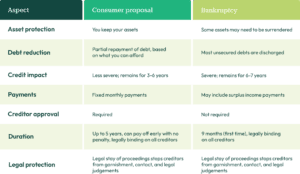
The sections below unpack each of these, but if you only read one thing, the table above is the core of the decision.
Two regulated debt solutions, one important decision
In Canada, bankruptcy and Proposals (Consumer and Division I) are the only two debt-relief solutions regulated by the federal government under the Bankruptcy and Insolvency Act. Both must be administered by a Licensed Insolvency Trustee, a professional licensed and overseen by the federal Office of the Superintendent of Bankruptcy to help people work through financial trouble.
A lot of people struggle to tell which option fits them, and that is normal. Neither is the “good” choice or the “bad” choice. Each one solves a different problem, and the goal here is simply to explain how each works and how to think about which may be right for you.
What is a consumer proposal?
A consumer proposal is a formal debt solution that lets you repay a portion of your unsecured debt over time, with the remaining balance legally forgiven once the proposal is complete. It is available to people who owe between $1,000 and $250,000 in unsecured debt (credit cards, tax debt, student loans, payday loans, and the like), excluding any mortgage on a principal residence.
To qualify, you need a reliable source of income and you must meet at least one of these: be a Canadian citizen, be a Canadian resident, own property in Canada, or do business in Canada. From there, a Licensed Insolvency Trustee reviews your income, expenses, assets, and debts, works out what you can realistically afford, and submits a proposal to your creditors offering partial repayment. If a majority of creditors (by dollar value) accept it, it becomes legally binding on all the creditors included.
The point of a consumer proposal is to reduce the total you owe, stop the interest, make the payments affordable and predictable, protect your assets, and give you a stable path out of debt.
What is bankruptcy?
Personal bankruptcy is a legal process for situations where repaying the debt simply is not realistic anymore. It gives you a structured way to eliminate most debts while being protected from creditors. When you file, most unsecured debts are eliminated once the process is complete, creditors must legally stop their collection efforts, and you are protected under federal law.
Bankruptcy is often described as “wiping out debt,” and while that is largely true, there can still be a payment component depending on your income and assets. Like a Consumer Proposal, it can only be administered by a Licensed Insolvency Trustee. The aim is a genuine financial reset: immediate legal protection from creditors and the elimination of unmanageable debt through what is called a discharge.
The core differences, explained
Debt repayment
With a consumer proposal, you repay a portion of your unsecured debt over time, with the amount based on what you can afford and what creditors are likely to accept. Bankruptcy does not involve negotiating a repayment offer. You do not repay the debt itself; instead, you may make monthly payments during the bankruptcy period depending on your income and whether you own certain non-exempt assets. Those payments are set by federal rules and reflect your ability to pay, not the size of the debt.
Asset protection
This is often the deciding factor. A Consumer Proposal lets you keep your assets, including your home, vehicle, savings, and investments. In bankruptcy, you may have to surrender non-exempt assets, and what you can keep depends on the exemption rules in your province.
Monthly payments and affordability
Consumer proposal payments are fixed, predictable, and based on what you can afford, and they do not increase if your income rises. Bankruptcy payments can change: if your income climbs above federal thresholds, you may owe surplus income payments, which raise the cost and extend the length of the bankruptcy.
Length of the process
A consumer proposal can run up to five years, though you can pay it off early. A first-time bankruptcy can be as short as nine months when no surplus income applies, or around 21 months when it does. The right timeline depends on your income, your dependants, and what is sustainable for you.
Impact on your credit
Both affect your credit, but a consumer proposal is generally less severe than bankruptcy. A consumer proposal is typically reported as an R7, which signals a formal arrangement to repay your debts, while bankruptcy is reported as an R9, the most severe rating on the R1 to R9 scale. (Some creditors report the individual accounts in a proposal as R9 while you are still paying, then update them to R7 once it is complete.)
According to the Financial Consumer Agency of Canada, a consumer proposal is removed from your credit report three years after you pay off the included debts, or six years after you sign it, whichever comes first. A first bankruptcy is removed about six years after discharge, and seven years at TransUnion in Newfoundland and Labrador, Ontario, Prince Edward Island, and Quebec. Credit matters, but it should not be the only factor: many people start rebuilding during or shortly after the process through budgeting, secured credit, and consistent payments.
Creditor approval
A consumer proposal needs creditor approval; it becomes binding once a majority accepts. Bankruptcy does not require creditor approval, because it is a legal right once you meet the insolvency criteria.
Which is better, a consumer proposal or bankruptcy?
There is no universal answer. A consumer proposal may make sense if you can afford partial repayment, you want to protect assets, and you need predictable monthly payments. Bankruptcy may be the better fit if your debt is unmanageable even with reduced payments, your income is limited, or you need a faster reset. The honest answer for most people only emerges after a Licensed Insolvency Trustee looks at the full picture.
Common misconceptions
Plenty of people avoid getting help because of fear or stigma, so it is worth clearing a few things up. Bankruptcy is not the end of your financial life; most people rebuild their credit, stability, and confidence after completing it. Not everyone loses their house or car, since provincial exemption rules protect essential assets and alternatives often exist. These solutions exist precisely because life happens, and they are tools, not judgments.
Why a Licensed Insolvency Trustee matters
A Licensed Insolvency Trustee is required by law to explain all of your debt-relief options and follow strict federal guidelines. Unlike unregulated debt consultants, a Trustee offers free, confidential consultations, real legal protection, and clear explanations without pressure. Talking to one cuts through the misinformation and helps you avoid costly mistakes.
How to decide which option is right for you
Choosing the right path means looking at your income stability, the types of debt you carry, your assets, your family’s needs, and your timing. Acting early tends to create more options, while waiting often closes them off. The goal is not just to clear the debt, but to set up a real, lasting financial recovery.
Get help choosing between bankruptcy and a consumer proposal
Both bankruptcy and consumer proposals are legitimate, regulated solutions built to help Canadians move forward, and asking for help is a practical step toward stability rather than a failure. Bromwich+Smith offers free, confidential consultations with Licensed Insolvency Trustees who can review your situation and explain your options clearly. If you are unsure which path fits, talking it through with a professional before you decide can make all the difference.
Frequently asked questions
What is the main difference between bankruptcy and a consumer proposal?
It comes down to repayment and asset protection. A consumer proposal lets you repay part of your unsecured debt over time with fixed payments while keeping your assets. Bankruptcy eliminates most unsecured debt but may involve surrendering non-essential assets, and its payments can change with your income.
Is a consumer proposal better than bankruptcy?
A consumer proposal often makes sense if you can afford partial repayment and want payment certainty or asset protection. Bankruptcy may be the better choice when repayment is not realistic. The right answer depends on your circumstances.
Will bankruptcy clear all my debts?
It clears most unsecured debts, but some obligations cannot be eliminated, such as child support, alimony, court fines, and certain student loans. A Licensed Insolvency Trustee can tell you exactly which of your debts would be covered.
How long does a consumer proposal last compared to bankruptcy?
A consumer proposal can run up to five years, though it can be paid off early. A first-time bankruptcy may last as little as nine months, depending on your income.
How do bankruptcy and consumer proposals affect my credit?
A consumer proposal is generally reported as an R7, and bankruptcy as an R9. Both affect your credit, but many people begin rebuilding during or shortly after completing the process.
Do creditors have to agree to bankruptcy?
No. Bankruptcy does not require creditor approval. consumer proposals do require creditor acceptance, which can affect certainty and timing.
Can I switch from a consumer proposal to bankruptcy?
In some cases, yes. If a consumer proposal becomes unaffordable, bankruptcy may be an option. A Licensed Insolvency Trustee can explain how that works and whether it applies to you.
Sources
- Bankruptcy and Insolvency Act (federal regulation of proposals and bankruptcy; stay of proceedings)
- Office of the Superintendent of Bankruptcy (Trustee oversight; bankruptcy duration and surplus income rules); Division I proposals
- Financial Consumer Agency of Canada, “How long information stays on your credit report” (canada.ca)
- Equifax and TransUnion R1 to R9 credit rating definitions


Related articles

Can you get credit after debt relief? What to know about rebuilding your credit
There’s a question almost everyone asks before they file for a consumer proposal or bankruptcy: will I ever be able to get credit again? It’s…


The payday loan cycle: Are you in it? And how to break the cycle.
It is the Thursday before payday, and you are $200 short. Rent already came out, the car needed a small repair, and the grocery bill…

Back-to-school expenses: How to budget and avoid debt
You are on the couch, half-watching TV, when a back-to-school commercial comes on. It’s that time of year again. Your brain starts building the list…